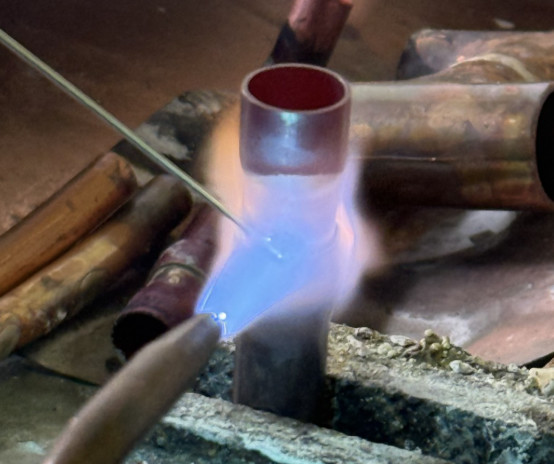
 Brazing is a cornerstone of modern manufacturing. As a permanent metal-joining process, it offers a unique balance of reliability, repeatability, and versatility. From the HVAC systems in our homes to the high-performance heat exchangers in electric vehicles, brazing allows engineers to assemble complex components without compromising the integrity of the base materials.
In this guide, we break down the metallurgical principles of brazing, how it stands apart from welding, and why choosing the right alloys and fluxes is non-negotiable for a high-quality joint.
What is Brazing? The Technical Definition
At its core, brazing is a joining process where two or more metal items are bonded by flowing a filler metal—the brazing alloy—into the joint.
The defining characteristic of brazing is that the filler metal has a lower melting point than the adjoining metals. Unlike welding, the base materials remain solid throughout the process.
The Three Pillars of a Brazed Joint:
- Lower Melting Point: The alloy melts, but the parts do not.
- Solid Base State: Components maintain their structural integrity and metallurgical properties.
- Capillary Action: The “magic” of the process—the molten alloy is drawn into the gap between parts.
The Physics of the Joint: Capillary Action
Capillary action is the physical phenomenon that pulls the molten alloy into the joint gap. However, this isn’t automatic. For a successful bond, three conditions must be met:
- Precision Clearance: The gap must be tight enough to pull the liquid metal in, but wide enough to allow it to flow. Typically, this is between 0.05 mm and 0.15 mm.
- Surface Purity: Surfaces must be chemically clean and free of oxides.
- Wetting Agents: In most environments, a flux is required to ensure the alloy “wets” the surface rather than beading up.
Soft vs. Hard Brazing: Know Your Temps
Industrial applications generally categorise brazing based on the working temperature and the strength of the resulting bond.
| Feature | Soft Brazing (Soldering) | Hard Brazing |
| Temperature | Below 450 °C | Above 450 °C |
| Common Fillers | Tin-based alloys | Silver, Copper, or Nickel-based |
| Strength | Moderate; ideal for electronics | High; structural and pressure-rated |
| Applications | Light-duty assemblies, PCB boards | Automotive, HVAC, Aerospace |
Brazing vs. Welding: Which Should You Choose?
While both create permanent bonds, they serve different masters. Welding is about fusion (melting everything together), while brazing is about metallurgical bonding.
Why choose Brazing over Welding?
- Join Dissimilar Metals: Want to bond copper to stainless steel? Brazing makes this easy; welding makes it a nightmare.
- Minimise Distortion: Since you aren’t melting the base parts, there is significantly less thermal warping.
- High-Volume Repeatability: Brazing is easily automated via induction or furnace processes, ensuring every joint is identical.
The Secret Sauce: Alloys and Fluxes
- Brazing Alloys
The alloy is the “glue” that holds the assembly together. It determines the joint’s mechanical strength, electrical conductivity, and corrosion resistance.
- Copper-Phosphorus: Self-fluxing on copper, great for HVAC.
- Silver-Based: The “all-rounder” for high-strength, multi-metal applications.
- The Role of Flux
When you heat metal, it oxidizes. This oxide layer acts as a barrier, preventing the alloy from bonding. Flux is the solution:
- It dissolves existing oxides.
- It prevents new oxides from forming during the heating cycle.
- It promotes “wetting,” allowing the alloy to spread smoothly.
Note: Choosing an incompatible flux is the #1 cause of joint failure in industrial settings.
Why Brazing Wins in Industry
From its ability to handle delicate components to its adaptability in automated furnace lines, brazing remains a strategic choice for:
- Pressure Tightness: Essential for plumbing and gas lines.
- Vibration Resistance: Superior to mechanical fasteners in high-stress environments.
- Aesthetics: Produces clean, smooth joints that require little to no finishing.
Summary
Brazing is more than just “high-temperature soldering.” It is a sophisticated metallurgical process that requires a harmony between joint design, heat control, and material science. When executed correctly, it produces joints that are often stronger than the base metals themselves.