How to Improve Brazed Joint Quality and Reduce Scrap
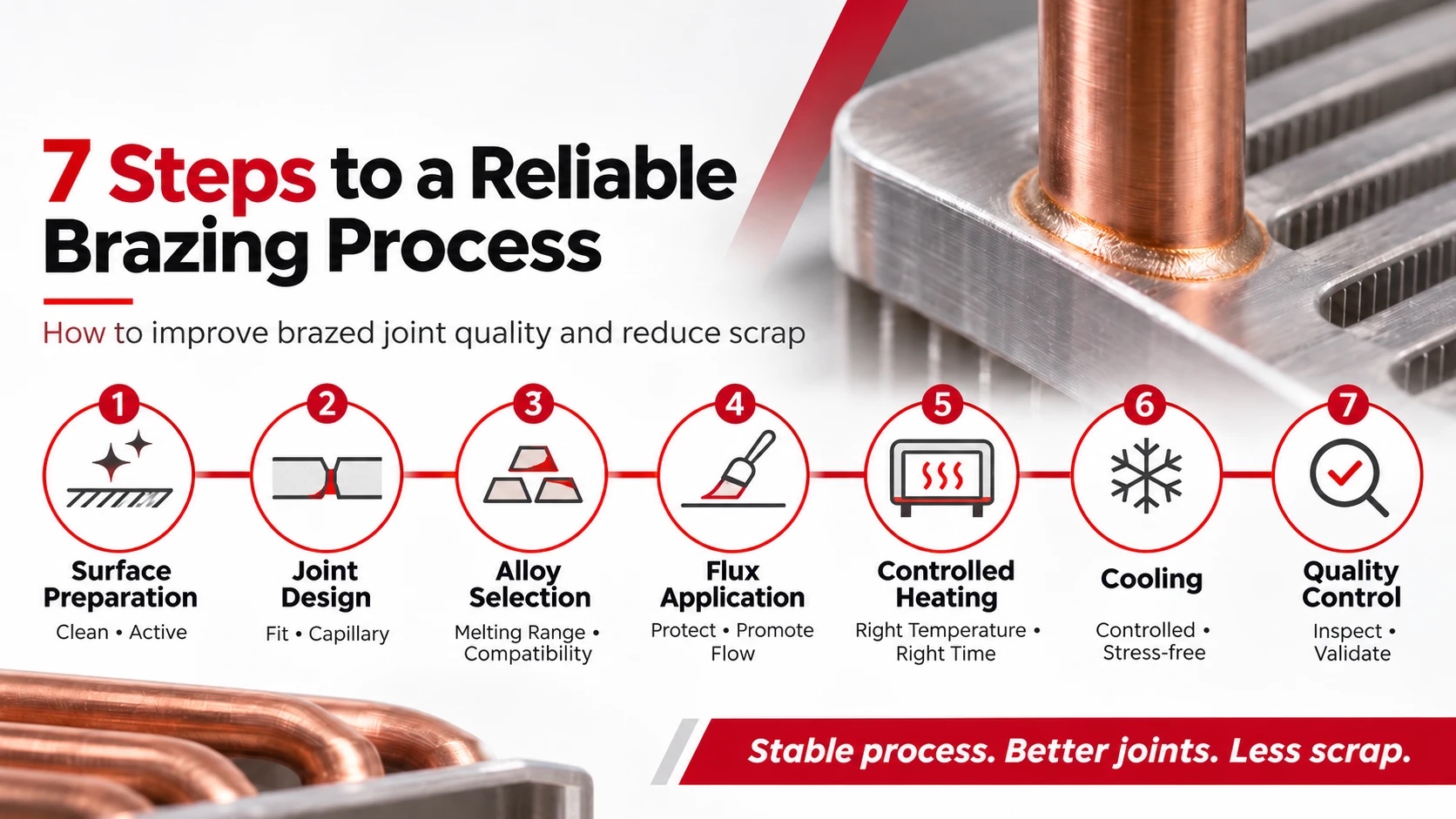 Materials, process control and best practices for more stable and repeatable industrial brazing
In an industrial brazing process, achieving a technically correct joint is not enough: the real goal is to achieve the same quality consistently and repeatably, even in high-volume production.
Scrap, rework, incomplete joints or variable results can significantly affect productivity and production costs.
The quality of a brazed joint depends on the interaction of numerous factors:
- surface preparation
- joint design
- choice of brazing alloys
- choice and application of brazing fluxes
- amount of filler material
- heating technique
- temperature control
- positioning of components
- cooling
- final inspection
To reduce scrap it is therefore necessary to consider brazing as a complete process, in which every stage must be controlled and standardized.
In this article we analyze the main aspects that can help improve the quality of the brazed joint and make the production process more stable and efficient.
Quality must be designed into the process
One of the most frequent mistakes is trying to correct problems only at the end of production.
In reality, joint quality is determined well before the final inspection stage.
A reliable process must be designed from the outset by considering:
Materials to be joined
↓
Joint geometry
↓
Brazing alloy
↓
Flux
↓
Heating method
↓
Process parameters
↓
Final inspection
Acting preventively on these elements reduces the likelihood of defects arising during production.
-
Start with correct joint design
Joint geometry is one of the fundamental elements of brazing.
The molten alloy must be able to flow between the components through capillary action.
An incorrect clearance can compromise the distribution of the filler material and lead to uneven results.
Excessive clearance
It can cause:
- reduced capillary action
- higher alloy consumption
- material build-up
- reduced repeatability
Insufficient clearance
It can prevent the alloy from penetrating the joint correctly.
It must also be considered that the gap between components changes during heating due to the thermal expansion of the materials.
Joint design should therefore take into account not only dimensional tolerances at room temperature, but also the conditions present at brazing temperature.
-
Prepare surfaces correctly
The brazing alloy must be able to wet the materials to be joined properly.
Oils, greases, oxides, machining residues or contaminants can hinder this stage.
Insufficient surface preparation can cause:
- poor wettability
- incomplete filling
- uneven alloy distribution
- localized defects
- reduced joint strength
Before brazing it may therefore be necessary to carry out:
- degreasing
- mechanical cleaning
- chemical cleaning
- oxide removal
It is also important to avoid excessively long intervals between surface preparation and brazing, because the materials may become contaminated or oxidized again.
-
Choose the brazing alloy correctly
The choice of brazing alloys directly influences quality, process temperature, wettability, strength and reliability of the joint.
The alloy must be selected considering:
- base materials
- brazing temperature
- operating conditions
- mechanical stresses
- thermal cycles
- joint geometry
- heating method
- level of automation
Silver-based alloys
Silver-based brazing alloys are one of the most versatile solutions for high-reliability industrial applications.
They generally offer:
- excellent wettability
- good fluidity
- relatively low brazing temperatures
- high ductility
- compatibility with many materials
They can be particularly suitable when reliable joints are required on steels, stainless steels, copper and copper alloys.
CuP alloys
Copper-phosphorus (CuP) alloys are widely used for copper-to-copper brazing, especially in the HVAC and refrigeration sectors.
Under certain conditions, the presence of phosphorus provides a self-fluxing action on copper.
CuPAg alloys
Copper-phosphorus-silver (CuPAg) alloys combine the characteristics of CuP alloys with greater ductility and better performance in applications subject to vibration or thermal cycling.
The choice of alloy should therefore be based on the overall process and not simply on the cost of the material.
A more suitable alloy can reduce scrap, rework and cycle times, improving overall production efficiency.
4. Use the correct flux
In processes carried out in air, brazing fluxes play an essential role.
During heating, in fact, metal surfaces tend to oxidize.
The flux has the function of:
- remove oxides
- protect surfaces during heating
- improve alloy wettability
- promote correct flow of the filler material
The selection must consider:
- base materials
- alloy used
- temperature range
- time at brazing temperature
- heating method
The amount applied is also important.
An insufficient amount may not protect the joint properly, while excessive application can increase the residues to be removed after the process.
To obtain repeatable results it is therefore advisable to standardize flux application as well.
-
Control the amount of brazing alloy
A larger amount of filler material does not automatically mean a better joint.
If the joint is correctly designed, the alloy must be drawn into the space between the components by capillary action.
Excess alloy can result in:
- external build-up
- increased material consumption
- greater need for cleaning
- dimensional variations
- increased costs
An insufficient amount, on the other hand, can leave areas that are not completely filled.
In series production it is therefore particularly useful to define a precise and repeatable amount of alloy.
-
Use rings and preforms to improve repeatability
In automated or high-volume industrial production, the use of brazing alloy rings and preforms can contribute significantly to reducing scrap.
A preform makes it possible to place a predetermined amount of alloy directly at the point of use.
The main advantages include:
- consistent alloy dosing
- reduced excess material
- greater repeatability
- simpler automation
- reduced dependence on the operator
- faster assembly
The shape of the preform can be designed to suit the geometry of the component, making it easier to position and integrate into the production line.
-
Control the thermal cycle
Temperature control is one of the most critical aspects of brazing.
Insufficient temperature
It can cause:
- poor wettability
- lack of penetration
- uneven alloy distribution
Excessive temperature
It can instead result in:
- heavy oxidation
- flux degradation
- changes in alloy behaviour
- deformation of components
- possible metallurgical changes
In addition to the maximum temperature, it is also important to control the time spent at high temperature.
A correct thermal cycle must therefore ensure:
- uniform attainment of temperature
- complete melting of the alloy
- sufficient time for capillary action
- absence of prolonged overheating
-
Choose the most suitable heating technique
The technology used to generate heat can significantly affect process repeatability.
Torch brazing
It offers great flexibility, but the result can be more strongly influenced by operator experience.
To increase repeatability it is important to standardize:
- flame position
- distance from the component
- heating time
- sequence of movements
Induction brazing
It allows heating that is:
- fast
- localized
- controllable
- highly repeatable
It is therefore particularly attractive in automated production.
Furnace brazing
It allows precise and uniform control of the thermal cycle and is particularly suited to series production and complex assemblies.
The choice must be made considering production volume, geometry, materials and the level of automation required.
-
Reduce operator variability
In manual processes, a significant part of the variability can be related to the operator.
Seemingly small differences can produce different results:
- amount of alloy
- amount of flux
- flame position
- heating duration
- operating sequence
To reduce these differences it is useful to define clear and easily replicable procedures.
Where possible, some operations can be standardized through:
- dispensers
- preforms
- positioning systems
- automatic heating
- cycle time control
The aim is not necessarily to automate the whole process, but to make the variables that most influence the result controllable.
-
Ensure correct positioning of components
During brazing, and especially during solidification, the components must remain in the intended position.
Movement or vibration can compromise the formation of the joint.
The use of positioning fixtures or clamping systems can improve:
- alignment
- joint clearance
- repeatability
- final quality
Fixture design should also take into account the thermal expansion of the components.
-
Control cooling as well
Brazing does not end when the heat source is removed.
Cooling is a stage of the process and must take place under controlled conditions.
Moving components when the alloy has not yet completely solidified can cause:
- misalignment
- micro-discontinuities
- reduced strength
- dimensional variability
It is therefore important to also define when the component can be handled or subjected to subsequent production stages.
-
Define appropriate quality controls
Not all components require the same level of inspection.
Depending on the application, the following may be used:
- visual inspection
- dimensional checks
- leak tests
- mechanical tests
- metallographic examination
- functional tests
- electrical tests
The frequency and type of inspections must be proportionate to the criticality of the component and the production process.
An effective system should also make it possible to detect negative trends before they generate significant quantities of scrap.
From Quality Control to Process Control
An effective approach to reducing scrap should not be limited to separating conforming from non-conforming components at the end of the line.
It is more effective to control the parameters that determine quality during the process.
| Parameter | Variable to control | Potential benefit |
|---|---|---|
| Surface preparation | Cleanliness and oxidation | Better wettability |
| Geometry | Joint clearance | Better capillary action |
| Brazing alloy | Composition and quantity | More consistent quality |
| Flux | Type and dosage | Less oxidation |
| Temperature | Thermal cycle | Greater repeatability |
| Positioning | Alignment | Fewer defects |
| Cooling | Solidification time | Greater stability |
| Inspection | Parameters and results | Early detection of drift |
How to reduce scrap in practice
An effective strategy can be summarized in five steps.
- Standardize
- Define clear parameters for:
- materials
- preparation
- alloy
- flux
- temperature
- times
- quantities
- Define clear parameters for:
- Measure
- Monitor the variables that really matter for the process.
- Reduce variability
- Use tools, preforms, positioning systems or automation when they can make the process more stable.
- Analyze defects
- Do not simply scrap the component: identify the cause that generated the problem.
- Improve continuously
- Use the data collected to progressively refine the process.
A stable process brings benefits beyond quality
Improving brazing does not only mean reducing the number of non-conforming parts.
A more stable process can lead to:
- reduced scrap
- less rework
- lower brazing alloy consumption
- lower flux consumption
- shorter cycle times
- higher productivity
- less dependence on the operator
- greater reliability of the final product
In other words, quality and production efficiency are closely linked.
Conclusion
The quality of a brazed joint does not depend on a single parameter, but on the balance between materials, geometry, brazing alloy, flux, heating and process control.
Reducing scrap therefore means acting on the entire production cycle, seeking to eliminate sources of variability before they can generate defects.
Correct joint design, the choice of the most suitable materials, control of the thermal cycle and standardization of operations make it possible to achieve more stable and repeatable brazing.
The ultimate goal is not simply to produce a good joint, but to produce thousands of joints with the same level of quality.
Thessco Solutions for Brazed Joint Quality
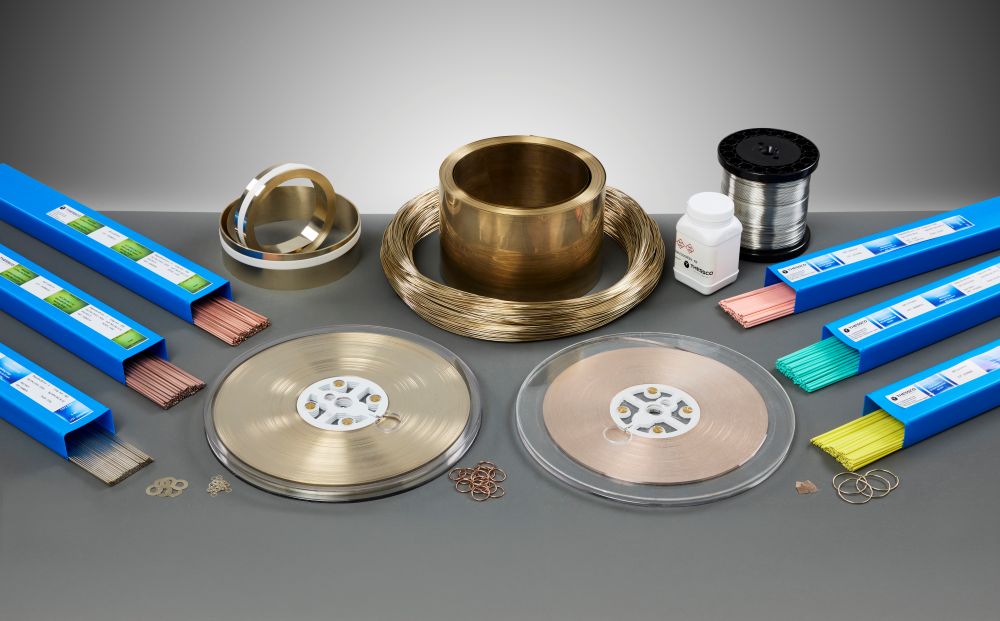 Thessco offers a complete range of materials to support different industrial brazing processes:
The range includes:
- silver-based brazing alloys
- copper-phosphorus (CuP) alloys and copper-phosphorus-silver (CuPAg) alloys
- wires, rods, strips and foils
- rings and preforms for controlled alloy dosing
- AGELCA Eco Green brazing fluxes
- solutions developed to combine high brazing performance with a formulation geared towards greater attention to safety and sustainability
The right combination of brazing alloy, format, flux and process technology can help reduce production variability, improve the quality of the brazed joint and limit scrap.