Key Requirements and Applications
Materials, solder alloys and process control for reliable electrical joints
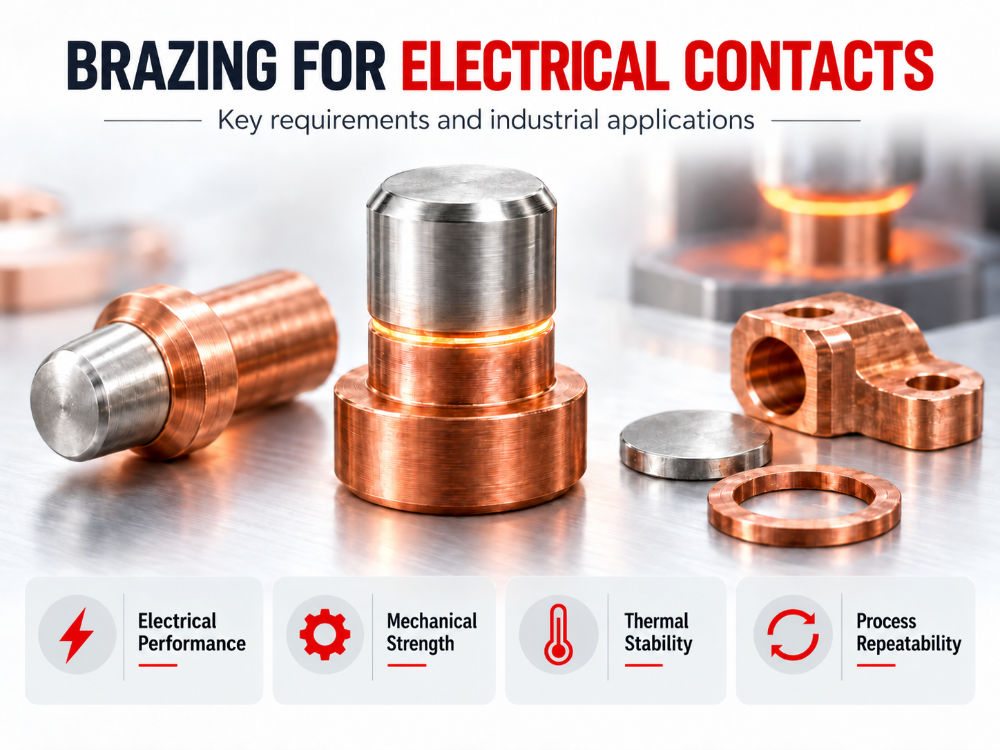 In the electrical contact sector, the quality of the connection between the various components is fundamental to guaranteeing the reliability, durability and performance of the device.
Relays, contactors, switches, terminals, protection devices and many other electrical components must in fact work in conditions characterised by:
- current flow;
- repeated thermal cycles;
- vibrations;
- mechanical stresses;
- possible electric arcs;
- locally high temperatures.
In many of these applications, brazing represents a particularly effective technology for joining dissimilar materials and creating mechanically strong and repeatable connections.
However, making a good joint in electrical contactors requires careful consideration of base materials, solder alloy, joint geometry, heating technique, and process control.
In this article we analyze the main requirements of brazing applied to electrical contacts and some of the most important aspects to consider when designing the process.
Why Use Brazing in Electrical Contacts?
Many electrical components are made of different materials, selected to perform specific functions.
For example, a component can combine:
- a copper or copper alloy support, chosen for its high conductivity;
- a contact material with specific characteristics of resistance to arcing, wear or high temperatures;
- a filler material used to create the connection between the two elements.
In these cases, brazing allows you to obtain a permanent union without melting the base materials.
The brazing alloy melts and penetrates the joint by capillary action, creating a metallurgical bond between the surfaces.
Among the main advantages of brazing in electrical contacts we find:
- possibility of combining different materials;
- high mechanical resistance of the joint;
- good process repeatability;
- temperatures lower than the melting of the base materials;
- possibility of automating production;
- compatibility with complex geometry components;
- possibility of precisely measuring the quantity of alloy used.
The Main Requirements of an Electrical Brazed Joint
A joint used in an electrical component must normally satisfy several requirements at the same time.
Mechanical resistance
The connection must withstand the stresses generated during assembly and operation of the component.
Vibrations, opening and closing cycles, thermal expansion and mechanical shocks can subject the joint to repeated stresses.
For this reason, the brazing alloy must ensure an adequate combination of:
- resistence;
- ductility;
- ability to absorb stresses;
- stability over time.
Electrical performance
In electrical contacting, particular attention must also be paid to the electrical behavior of the assembly.
The brazed area should not introduce unnecessarily high contact resistances or discontinuities in the current path.
It is important to underline, however, that the conductivity of the joint depends on the entire system:
- basic materials;
- brazing alloy;
- joint geometry;
- thickness of the brazed area;
- metallurgical quality of the interface.
For this reason, the goal is not simply to choose the alloy with the highest possible conductivity, but to design a joint that simultaneously guarantees adequate electrical, mechanical, and manufacturing characteristics.
Resistance to thermal cycling
The passage of current generates heat.
Additionally, many electrical devices operate through repeated on-off cycles.
The brazed joint can therefore be subjected to continuous temperature variations.
When materials with different coefficients of thermal expansion are joined, these variations can generate stresses within the joint.
A sufficiently ductile alloy can help absorb these stresses and reduce the risk of cracking or failure over time.
The Materials used in Electrical Contacts
Electrical contact uses a wide variety of materials.
Among the most common base materials we find:
- copper;
- brass;
- copper alloys;
- steels;
- silver-based materials;
- composite materials intended for electrical contacts.
Contact materials can be chosen according to the characteristics required by the application, such as:
- conductivity;
- arc resistance;
- wear resistance;
- high temperature stability;
- contact welding resistance.
The presence of different materials makes the study of the metallurgical compatibility between base material, contact material and brazing alloy particularly important.
Choosing the Brazing Alloy
he choice of brazing alloy represents one of the most important aspects in process design.
In many electrical contact applications, silver-based alloys are used, thanks to their combination of:
- excellent wettability;
- good fluidity;
- relatively low brazing temperatures;
- high joint reliability;
- good ductility;
- compatibility with numerous metallic materials.
However, the percentage of silver and the composition of the alloy must be evaluated according to the application.
Brazing temperature
A lower operating temperature can be an advantage when components are sensitive to heat.
Reducing heat intake can help limit:
- deformations;
- metallurgical alterations;
- oxidation;
- damage to other elements present in the assembly.
Wettability
The alloy must be able to properly wet the materials to be joined.
Insufficient wettability can cause:
- incomplete filling;
- non-brazed areas;
- reduced resistance;
- results that are difficult to repeat.
The compatibility between alloy, base material and flux must therefore be evaluated as a whole.
Ductility
In applications subject to vibration or thermal cycling, good joint ductility can be an important advantage.
In fact, it allows for the absorption of part of the tensions generated by the different thermal expansions of the materials.
Joint Geometry and Capillarity
As in all brazing applications, the geometry of the joint also plays a fundamental role in electrical contact applications.
The molten alloy must be able to penetrate between the surfaces thanks to capillary action.
Incorrect play can compromise the process.
Game too high
It can determine:
- reduction of capillary action;
- increased alloy consumption;
- accumulation of material;
- lower repeatability.
Game too small
It can instead prevent the alloy from fully penetrating the joint.
The design must also consider the differences in thermal expansion of the materials during the brazing cycle.
Heat Control
In the production of electrical components it is often necessary to limit heating to only the areas affected by the brazing.
Excessive heat input can in fact alter the characteristics of the component or damage sensitive materials.
For this reason, different heating techniques are used.
Flame brazing
It can be used for relatively flexible production or for larger components.
The result, however, depends significantly on the operator’s control.
Induction brazing
Induction brazing is particularly interesting for electrical contacts because it allows for heating:
- quick;
- localized;
- controllable;
- highly repeatable.
It also lends itself very well to automation and mass production.
Oven braising
For some types of components and large production volumes, oven brazing can also be used.
The main advantage is the great uniformity of the thermal cycle and the possibility of processing numerous components simultaneously.
The Role of Deoxidizers
When brazing is performed in the presence of air, the formation of oxides can significantly compromise the process.
The brazing flux therefore performs an essential function:
- removes surface oxides;
- protects materials during heating;
- improves wettability;
- facilitates the flow of the alloy.
The choice of the deoxidizer must be made considering:
- materials to be joined;
- brazing alloy;
- process temperature;
- heating method;
- any subsequent cleaning requirements.
In processes performed in controlled atmospheres or under vacuum, the use of flux may be reduced or not necessary, depending on the application.
Preforms and Control of the Quantity of Alloy
In industrial production of electrical contacts, one of the most important aspects is repeatability.
Using a variable amount of alloy can generate significant differences between one component and another.
For this reason the following are often used:
- rings;
- washers;
- discs;
- segments;
- specific shapes;
- other types of brazing alloy preforms.
A preform allows a predetermined amount of alloy to be introduced into the joint.
This allows you to:
- reduce variability;
- limit excess alloy;
- improve repeatability;
- simplify automation;
- reduce waste;
- increase productivity.
The geometry of the preform can also be developed according to the shape of the component to be brazed.
Brazing and Automation
The electrical contact industry is often characterized by large-volume production.
For this reason, many processes are designed for automation from the outset.
An automated line can control:
| Component placement | Preformed / alloy | Deoxidizer | Heating | Time at Temperature | Cooling | Final Inspection |
|---|
Standardizing these steps helps reduce differences between one piece and another and improves the overall stability of the process.
Typical Applications
Brazing can be used in different components in the electrical and electromechanical sector.
Among the applications we can find:
- Relay: Connection of contact elements and materials to their metal supports.
- Contactors: Assembly of components intended to handle frequent switching cycles and high currents.
- Switches and Protection Devices: Components requiring high mechanical and electrical reliability.
- Terminals and Connections: Assemblies in which control of electrical resistance and mechanical robustness is particularly important.
- Electrical Distribution Devices: Components used in electrical panels, distribution equipment and industrial systems.
Main Critical Issues to Check
| Parameter | Possible problem | Aspects to check |
|---|---|---|
| Surface | Poor wettability | Cleaning and oxidation |
| Joint game | Incomplete filling | Geometry and tolerances |
| Amount of alloy | Accumulations or incomplete areas | Dosage / preformed |
| Temperature | Alteration of materials | Thermal cycle |
| Deoxidizer | Residue of poor wettability | Compatibility and quantity |
| Positioning | Non-uniform joints | Fixing the components |
| Process | Variability | Automation and standardization |
The same defect can be generated by multiple causes: for this reason the analysis must always consider the entire brazing system.
Joint Quality and Process Control
In electrical components, the quality of the joint must be evaluated not only from an aesthetic point of view.
Depending on the application, checks may be required relating to:
- correct distribution of the alloy;
- joint filling;
- mechanical resistance;
- dimensions and geometry;
- connection continuity;
- electrical performance;
- resistance to thermal cycling.
The level and type of control must be defined based on the component requirements and conditions of use.
Conclusion
Brazing in electrical contact applications requires a balance between mechanical performance, electrical characteristics, and production process stability.
The quality of the result depends on the correct combination of:
- materials to be joined;
- brazing alloy;
- joint geometry;
- deoxidizer;
- warm-up technique;
- amount of alloy;
- thermal cycle control.
In particular, in high-volume production, the use of preforms and automated processes can significantly improve repeatability and reduce variability between components.
Correct process design therefore allows not only to obtain reliable joints, but also to reduce waste, improve productivity and increase the reliability of the final device.
Thessco Solutions for Electrical Contacts
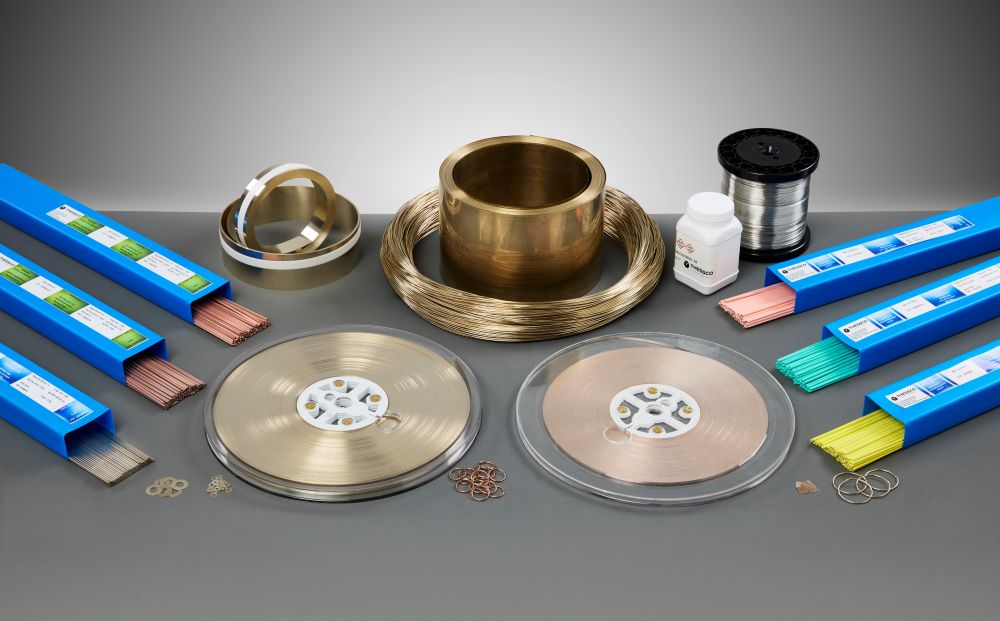 Thessco offers a variety of solutions for applications in the electrical and electromechanical sectors, with a particular focus on the quality and repeatability of industrial processes.
The range includes:
- silver-based brazing alloys;
- alloys available in different melting ranges and compositions;
- threads, ribbons and sheets;
- rings and preforms that can be developed according to the geometry of the component;
- AGELCA Eco Green brazing fluxes;
- solutions dedicated to manual and automated processes.
The correct combination of alloy, format, flux and brazing technology allows for the development of more reliable processes suited to the specific needs of electrical contact applications.